Vulnerability management
CVSS 4.0 Score Calculator vs CVSS 3.1: What Changed in Vulnerability Scoring
How CVSS v4 differs from CVSS 3.1: new metric groups, Attack Requirements, Threat metrics, MacroVector scoring, worked examples and how to use a CVSS 4.0 score calculator.
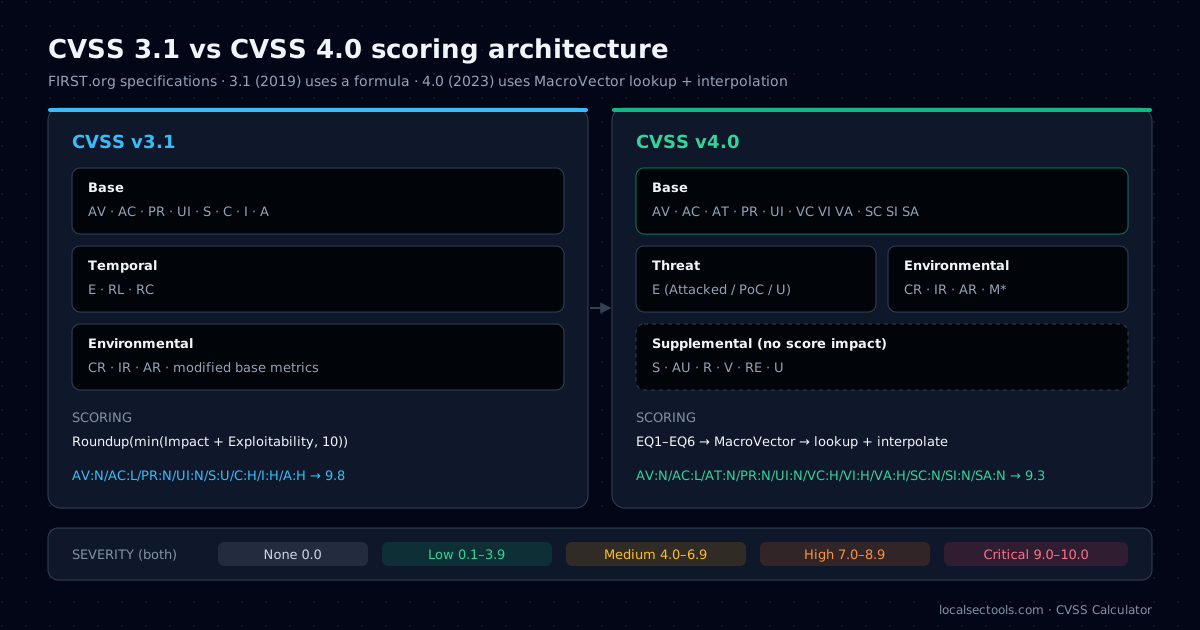
CVSS v4 is the version of the Common Vulnerability Scoring System that FIRST published on 1 November 2023. It keeps the familiar 0–10 score and severity bands of CVSS 3.1, but it changes the metrics underneath and replaces the 3.1 formula with a lookup model. A CVSS 4.0 score calculator is now the practical way to get a correct number.
Vulnerability triage is part of my SOC work, and the move from 3.1 to 4.0 confuses many teams. This guide compares the two versions, shows how each score is built, and gives a workflow you can follow today. Every vector here can be checked in the CVSS calculator, which scores both versions in your browser.
What is the difference between CVSS 3.1 and 4.0?
CVSS 4.0 removes Scope, adds Attack Requirements and separate impacts on subsequent systems, replaces Temporal with a single Threat metric, and adds Supplemental metrics that do not change the score.
| Area | CVSS 3.1 | CVSS 4.0 |
|---|---|---|
| Metric groups | Base, Temporal, Environmental | Base, Threat, Environmental, Supplemental |
| Scope | S:U / S:C | Removed; replaced by subsequent-system impacts |
| Impact metrics | C, I, A | VC VI VA (vulnerable) and SC SI SA (subsequent) |
| New exploitability metric | none | AT Attack Requirements |
| User Interaction | None / Required | None / Passive / Active |
| Exploit maturity | Temporal E, RL, RC | Threat E only (Attacked / PoC / Unreported) |
| Scoring | Closed-form formula | MacroVector lookup plus interpolation |
| Naming | "Base score" | CVSS-B, CVSS-BT, CVSS-BE, CVSS-BTE |
The new names make clear which metrics went into a number. A vendor advisory usually publishes CVSS-B. Your team should aim to report CVSS-BTE, which adds threat and environment data.
What are the CVSS v4 base metrics?
CVSS v4 has 11 base metrics: five for exploitability (AV, AC, AT, PR, UI) and six for impact (VC, VI, VA, SC, SI, SA).
| Metric | Name | Values |
|---|---|---|
| AV | Attack Vector | Network, Adjacent, Local, Physical |
| AC | Attack Complexity | Low, High |
| AT | Attack Requirements | None, Present |
| PR | Privileges Required | None, Low, High |
| UI | User Interaction | None, Passive, Active |
| VC / VI / VA | Vulnerable system C / I / A | High, Low, None |
| SC / SI / SA | Subsequent system C / I / A | High, Low, None |
Attack Requirements covers conditions the attacker does not control, such as a race condition or a specific deployment setting. In 3.1 those details were squeezed into Attack Complexity.
The split between vulnerable and subsequent systems replaces Scope. A browser bug that compromises the page but not the operating system now scores high on VC and low on SC, instead of flipping one Scope switch.
How is a CVSS 4.0 score calculated?
CVSS 4.0 groups the metrics into six equivalence sets (EQ1–EQ6), looks up a score for the resulting MacroVector in a table set by FIRST experts, and then adjusts it within that group.
CVSS 3.1 used a formula. You can still compute it by hand, which makes the difference between the versions easy to see.
v3.1: ISS = 1 − (1 − C)(1 − I)(1 − A) Impact = 6.42 × ISS (scope unchanged) Exploitability = 8.22 × AV × AC × PR × UI Base = Roundup(min(Impact + Exploitability, 10))
CVSS 4.0 does not have an equivalent closed formula. The 270 possible MacroVectors each carry a score, and the final value moves down within its MacroVector based on how far the exact vector sits from the most severe vector in that group.
- Map the full vector to six equivalence-class values (EQ1 to EQ6).
- Combine them into a MacroVector such as
000000and look up its score. - Measure the severity distance from the highest vector in that MacroVector.
- Subtract the proportional distance and round to one decimal place.
Because of the lookup table, hand calculation is impractical for CVSS v4. Use a calculator that implements the FIRST reference tables, such as the CVSS 4.0 score calculator.
How do the same vulnerabilities score in 3.1 and 4.0?
An unauthenticated network RCE scores 9.8 in CVSS 3.1 and 9.3 in CVSS 4.0. A flaw that also fully compromises other systems scores 10.0 in both.
| Vulnerability | Version | Vector | Score |
|---|---|---|---|
| Unauthenticated RCE | 3.1 | AV:N/AC:L/PR:N/UI:N/S:U/C:H/I:H/A:H | 9.8 Critical |
| Unauthenticated RCE | 4.0 | AV:N/AC:L/AT:N/PR:N/UI:N/VC:H/VI:H/VA:H/SC:N/SI:N/SA:N | 9.3 Critical |
| RCE with full downstream impact | 3.1 | AV:N/AC:L/PR:N/UI:N/S:C/C:H/I:H/A:H | 10.0 Critical |
| RCE with full downstream impact | 4.0 | AV:N/AC:L/AT:N/PR:N/UI:N/VC:H/VI:H/VA:H/SC:H/SI:H/SA:H | 10.0 Critical |
The 4.0 vectors start with the CVSS:4.0/ prefix in practice; it is omitted above for width. Note how 4.0 keeps 10.0 for cases with real downstream damage, which leaves more room between "bad" and "worst case".
How do Threat and Environmental metrics change the score?
Threat (E) lowers the score when no exploitation is known. Environmental metrics adjust it for how important the affected asset is to you.
Exploit Maturity has three values: Attacked (E:A), POC (E:P) and Unreported (E:U). If you leave it as Not Defined, CVSS 4.0 assumes Attacked, the worst case. That default is deliberate, so do not lower a score without evidence.
Environmental metrics include Confidentiality, Integrity and Availability Requirements (CR, IR, AR) and modified versions of every base metric. A bug on an isolated lab host can drop a full severity band once MAV and CR reflect reality.
Supplemental metrics such as Safety, Automatable and Recovery never change the number. Use them in tickets to explain priority to engineers and managers.
What are the CVSS severity ratings?
Both CVSS 3.1 and 4.0 use the same bands: None 0.0, Low 0.1–3.9, Medium 4.0–6.9, High 7.0–8.9 and Critical 9.0–10.0.
| Rating | Score range | Typical response |
|---|---|---|
| None | 0.0 | No action |
| Low | 0.1 – 3.9 | Normal patch cycle |
| Medium | 4.0 – 6.9 | Patch within your standard SLA |
| High | 7.0 – 8.9 | Prioritize; consider mitigations |
| Critical | 9.0 – 10.0 | Emergency change, especially if exploited |
CVSS measures severity, not risk. Combine it with known-exploited data, such as the CISA KEV catalog, and with asset criticality before you set patch deadlines.
What is a practical workflow for scoring CVEs with CVSS v4?
Extract the CVE IDs, record the vendor vector, add threat and environmental metrics, and store the result next to your patch policy.
- Pull CVE IDs, hashes and URLs out of the advisory with the IOC Extractor.
- Enter the vendor vector in the CVSS calculator and keep both 3.1 and 4.0 strings during the transition.
- Set
Efrom threat intel andCR/IR/ARfrom your asset inventory, then record theCVSS-BTEscore. - Store the thresholds as code. Convert your SLA policy between JSON and YAML with the policy converter.
cvss_version: "4.0"
sla_days:
  critical: 7    # 9.0 – 10.0
  high: 30       # 7.0 – 8.9
  medium: 90     # 4.0 – 6.9
  low: 180       # 0.1 – 3.9
override:
  known_exploited: 3
This keeps the score, the evidence behind it and the deadline in one place. Auditors and engineers can then follow how each decision was made.
Should your team use CVSS 3.1 or CVSS 4.0?
Record both during the transition. Many advisories still publish only 3.1 vectors, while new CNA records increasingly include 4.0, so a single-version process will miss data.
Keep the version prefix with every vector, such as CVSS:3.1/ or CVSS:4.0/. A bare score of 9.8 or 9.3 means little unless you know which model produced it.
Do not convert one version into the other by hand. The metrics do not map one to one, because Scope has no direct 4.0 equivalent and Attack Requirements has no 3.1 equivalent. Score each version from the original vulnerability details instead.
Set your patch SLAs by severity band rather than exact decimals. The bands are identical in both versions, so the policy stays stable while the scores underneath change.
Frequently asked questions
FIRST published CVSS v4.0 on 1 November 2023.
Try it in your browser
- CVSS CalculatorScore vulnerabilities with CVSS v4.0 or v3.1, parse vector strings and see severity at a glance.
- IOC ExtractorExtract and defang indicators of compromise from reports and logs, then export CSV or JSON.
- JSON ⇄ YAML Policy ConverterConvert between JSON and YAML and lint AWS IAM policies and Kubernetes securityContext.
About the author: Asad Ali
IT Support Engineer and SOC analyst · Microsoft SC-200 & ISC2 CC certified
Asad Ali is an IT Support Engineer and SOC analyst with a Computer Science degree from UET Lahore. He holds the Microsoft SC-200 Security Operations Analyst and ISC2 Certified in Cybersecurity (CC) certifications, works on threat detection, network analysis and Linux administration, and builds and maintains every tool on LocalSecTools.
- Microsoft Certified: Security Operations Analyst (SC-200)
- ISC2 Certified in Cybersecurity (CC)
Every guide is written and technically reviewed by Asad Ali, and the commands and numbers are checked against the LocalSecTools calculators. Read more about his work at asadali.tech.